
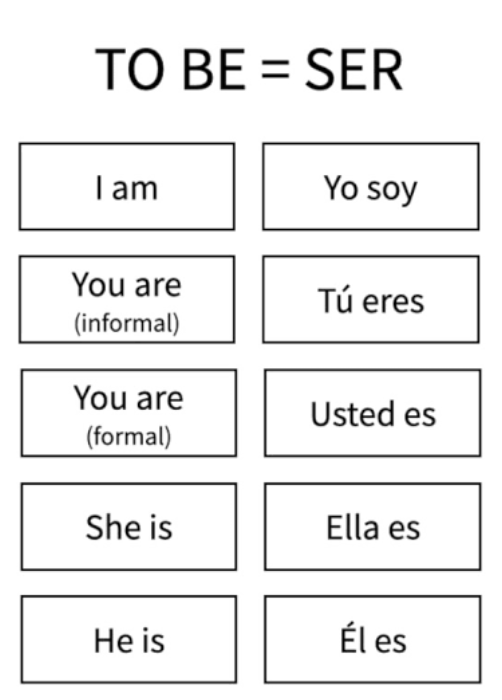
The good news is that the basic grammar is quite simple.
The difficult part for Spanish speakers is that English uses one verb — to be — where Spanish normally uses two different verbs: ser and estar.
- Soy estudiante. → I am a student.
- Estoy cansado. → I am tired.
- Ella es española. → She is Spanish.
- Ella está en casa. → She is at home.
In all four examples, English uses the same verb: to be.
In this guide, you will learn how to use the verb to be for Spanish speakers in English, how it compares with ser and estar, how to make negative sentences and questions, and how to avoid some of the most common mistakes Spanish speakers make.
What Does the Verb to Be for Spanish Speakers Mean?
The English verb to be can usually be translated as either ser or estar in Spanish.
This is one of the biggest differences between English and Spanish.
| Spanish | English |
|---|---|
| Yo soy profesor. | I am a teacher. |
| Yo estoy cansado. | I am tired. |
| Ella es inteligente. | She is intelligent. |
| Ella está feliz. | She is happy. |
| Somos de México. | We are from Mexico. |
| Estamos en México. | We are in Mexico. |
Spanish changes between ser and estar, but English continues using forms of to be.
This actually makes English easier in this area: you don’t have to decide whether to use ser or estar.
You only need to choose the correct form of to be.
Verb to Be For Spanish Speakers in the Present Simple
In the present tense, the verb to be has three main forms:
am, is, and are.
| Pronoun | Verb to Be | Example |
|---|---|---|
| I | am | I am happy. |
| You | are | You are happy. |
| He | is | He is happy. |
| She | is | She is happy. |
| It | is | It is beautiful. |
| We | are | We are happy. |
| They | are | They are happy. |
The easiest way to memorize this is:
- I → am
- He / She / It → is
- You / We / They → are
Examples of Verb to Be for Spanish Speakers
Let’s compare some common English sentences with their Spanish equivalents.
I am Brazilian.
Soy brasileño.
I am tired.
Estoy cansado.
She is my friend.
Ella es mi amiga.
She is at work.
Ella está en el trabajo.
We are students.
Somos estudiantes.
We are at school.
Estamos en la escuela.
Notice what happens again.
Spanish changes between ser and estar. English doesn’t.
We simply use:
am / is / are
Verb to Be For Spanish Speakers Contractions
Native English speakers very frequently use contractions.
Instead of saying:
I am happy.
You will usually hear:
I’m happy.
Here are the most important contractions:
| Full Form | Contraction |
|---|---|
| I am | I’m |
| You are | You’re |
| He is | He’s |
| She is | She’s |
| It is | It’s |
| We are | We’re |
| They are | They’re |
Examples:
- I’m from Colombia.
- You’re my friend.
- He’s a teacher.
- She’s tired.
- We’re ready.
- They’re at home.
If your goal is to understand natural spoken English, learning these contractions is extremely important.
Negative Sentences with the Verb to Be for Spanish Speakers
Making negative sentences with to be is easy.
Simply add not after the verb.
The structure is:
Subject + to be + not + complement
For example:
I am not tired.
No estoy cansado.
She is not a teacher.
Ella no es profesora.
We are not at home.
No estamos en casa.
They are not American.
No son estadounidenses.
You will also frequently see contractions:
- is not → isn’t
- are not → aren’t
Examples:
- He isn’t busy.
- She isn’t at home.
- We aren’t ready.
- They aren’t students.
With I am, the standard contraction is:
I’m not
For example:
I’m not angry.
How to Ask Questions with the Verb to Be For Spanish Speakers
This is an important difference between English and Spanish.
To make a question with the verb to be, put the verb before the subject.
Statement: You are tired.
Question: Are you tired?
| Statement | Question |
|---|---|
| She is happy. | Is she happy? |
| He is Spanish. | Is he Spanish? |
| They are ready. | Are they ready? |
| We are late. | Are we late? |
Compare this with Spanish:
¿Estás cansado? → Are you tired?
¿Ella es profesora? → Is she a teacher?
¿Están listos? → Are they ready?
A useful formula is:
To be + subject + complement?
For example:
- Are you hungry?
- Is Maria at home?
- Are they from Argentina?
Short Answers with To Be
English speakers often use short answers instead of repeating the entire sentence.
Are you tired?
Yes, I am.
No, I’m not.
Is Carlos from Spain?
Yes, he is.
No, he isn’t.
| Question | Positive | Negative |
|---|---|---|
| Are you…? | Yes, I am. | No, I’m not. |
| Is he…? | Yes, he is. | No, he isn’t. |
| Is she…? | Yes, she is. | No, she isn’t. |
| Are we…? | Yes, we are. | No, we aren’t. |
| Are they…? | Yes, they are. | No, they aren’t. |
Ser vs. Estar vs. To Be
For Spanish speakers, this is probably the most important concept in this lesson.
In Spanish:
ser ≠ estar
But in English:
- ser → to be
- estar → to be
Identity
Soy Jorge.
→ I am Jorge.
Profession
Soy profesor.
→ I am a teacher.
Nationality
Ella es mexicana.
→ She is Mexican.
Emotional State
Estoy feliz.
→ I am happy.
Physical State
Estamos cansados.
→ We are tired.
Location
Ellos están en casa.
→ They are at home.
English uses to be in all of these situations.
If you would use ser or estar in Spanish, there is a good chance you will need a form of to be in English.
It isn’t a perfect rule for every possible sentence, but it is extremely useful when you’re beginning.
Common Mistake: Forgetting the Subject or Verb
Spanish allows speakers to omit subject pronouns very frequently because the verb conjugation already tells you who is performing the action.
For example:
Estoy cansado.
You don’t necessarily need to say:
Yo estoy cansado.
English works differently. You normally need both the subject and the verb.
- ❌ Is tired.
- ✅ He is tired.
- ❌ Am happy.
- ✅ I am happy.
- ❌ Are students.
- ✅ They are students.
Remember: English normally requires an explicit subject.
Using To Be for Age
Spanish speakers commonly make mistakes with age because Spanish uses tener.
In Spanish:
Tengo 25 años.
A literal translation would be:
❌ I have 25 years.
But English uses the verb to be for age:
✅ I am 25 years old.
Or simply:
✅ I’m 25.
More examples:
Ella tiene 30 años.
→ She is 30 years old.
Mi hermano tiene 18 años.
→ My brother is 18 years old.
So remember:
- Spanish: tener + age
- English: to be + age
Be Careful with “Tengo Calor” and “Tengo Hambre”
Age isn’t the only situation where Spanish uses tener and English uses to be.
Spanish speakers should pay special attention to expressions such as:
Tengo hambre.
→ I am hungry.
Not:
❌ I have hunger.
Tengo sed.
→ I am thirsty.
Tengo calor.
→ I am hot.
Tengo frío.
→ I am cold.
Tengo miedo.
→ I am afraid.
This is an important pattern to learn because translating directly from Spanish often produces unnatural English.
Verb to Be in the Past: Was and Were
The verb to be changes in the past tense.
You only need two forms:
was and were
| Pronoun | Past Form |
|---|---|
| I | was |
| You | were |
| He | was |
| She | was |
| It | was |
| We | were |
| They | were |
Examples:
I was tired yesterday.
Estaba cansado ayer.
She was a teacher.
Ella era profesora.
We were at home.
Estábamos en casa.
They were happy.
Estaban felices.
Negative Sentences in the Past
Simply add not:
- was not → wasn’t
- were not → weren’t
Examples:
- I wasn’t tired.
- She wasn’t at home.
- We weren’t ready.
- They weren’t students.
Questions in the Past
Just like with am, is, and are, move the verb before the subject.
She was tired.
→ Was she tired?
They were at home.
→ Were they at home?
Examples:
- Were you busy yesterday?
- Was he your teacher?
- Were they in Spain?
Common Verb to Be Mistakes Spanish Speakers Make
1. Forgetting “to be”
❌ She beautiful.
✅ She is beautiful.
2. Using “is” with plural subjects
❌ They is happy.
✅ They are happy.
Remember:
- he / she / it → is
- you / we / they → are
3. Saying “I have 20 years”
❌ I have 20 years.
✅ I am 20 years old.
4. Using “do” with to be questions
❌ Do you are tired?
✅ Are you tired?
You don’t need do when the main verb is to be.
5. Saying “I am agree”
Spanish:
Estoy de acuerdo.
But English says:
❌ I am agree.
✅ I agree.
This is a good reminder that you shouldn’t translate every expression word for word.
Verb to Be for Spanish Speakers: Quick Cheat Sheet
Present
- I am
- You are
- He is
- She is
- It is
- We are
- They are
Past
- I was
- You were
- He was
- She was
- It was
- We were
- They were
Negative
- am not
- isn’t
- aren’t
- wasn’t
- weren’t
Questions
Move to be before the subject:
- Are you happy?
- Is she Spanish?
- Were they at home?
- Was he tired?
Practicing the verb to be for Spanish speakers with short translations is one of the easiest ways to make am, is, are, was, and were automatic.
Practice: Translate These Sentences into English
Try translating these sentences before looking at the answers.
- Soy estudiante.
- Estoy cansado.
- Ella es de México.
- Estamos felices.
- Ellos están en casa.
- Tengo 25 años.
- ¿Estás listo?
- Ella no está aquí.
- Ayer estaba cansado.
- ¿Eran estudiantes?
Answers
- I am a student.
- I am tired.
- She is from Mexico.
- We are happy.
- They are at home.
- I am 25 years old.
- Are you ready?
- She isn’t here.
- I was tired yesterday.
- Were they students?
If you made some mistakes, that’s completely normal. The goal is to start recognizing the patterns automatically.
Final Thoughts: Mastering the Verb to Be
The verb to be for Spanish speakers is one of the foundations of English grammar because it covers many of the functions expressed by ser and estar in Spanish.
For Spanish speakers, the most important thing to remember is that English to be performs many of the functions of both ser and estar.
In the present:
- I → am
- he / she / it → is
- you / we / they → are
In the past:
- I / he / she / it → was
- you / we / they → were
Once these forms become automatic, creating basic English sentences becomes much easier.
Don’t try to translate every sentence word for word from Spanish. Instead, learn English structures as patterns and compare them with Spanish when the comparison helps you understand the grammar.
Keep practicing with simple sentences every day, and soon am, is, are, was, and were will start to feel natural.

[…] English for Spanish Speakers: A Complete Guide to Learning English Verb to Be for Spanish Speakers: Complete Guide with 5 Examples […]